

The nominal group technique (NGT) is a structured decision-making method in which participants silently generate ideas, share them in turn, discuss as a group and then vote to produce a ranked list of priorities. In MindMeister, you can run every stage of an NGT session inside a single shared mind map, so ideas, discussion notes and final rankings all live in one visible, permanent record.
MindMeister, a collaborative mind mapping tool, makes running a nominal group technique session practical for in-person and remote teams: Everyone adds ideas to a shared mind map, the facilitator clusters them in real time and the final ranking stays visible to all at once. You can try the whole flow on the free plan before your next session.
What the nominal group technique is and how it works
The nominal group technique, often shortened to NGT, is a structured group decision-making method. It separates individual idea generation from group discussion, so every participant puts forward ideas before the group evaluates them together. The result is a prioritized list that reflects the whole team, not just its loudest members. That matters because you want a decision the whole group will support, not just the idea that sounded best out loud. As documented by SixSigma.us, Andre Delbecq and Andrew Van de Ven developed the method in the early 1970s, and it remains a standard approach in quality improvement and facilitation work.
An NGT session moves through 5 stages. First comes the introduction, where the facilitator explains the question and the ground rules. Second is silent idea generation: Each participant writes down ideas independently, with no discussion. Third is round-robin sharing, where each person offers a single idea at a time until the group captures them all. Fourth is the discussion, where the group clarifies, groups and refines the ideas and drops duplicates. Fifth is voting or ranking, where each participant ranks the ideas independently and the combined scores set the priorities. Two stages carry most of the weight here: the silent generation phase, which protects quieter voices, and the voting stage, which turns a long list into clear priorities. The American Society for Quality describes NGT as a structured method that draws on contributions from everyone and helps a team quickly agree on the relative importance of ideas, which is exactly what silent generation and independent voting are built to do.
How to run an NGT session in MindMeister
Here is how to run the 5 stages inside a shared mind map. A visual mind map suits NGT well, because you can capture ideas, cluster them and rank them in a single place that everyone sees. To keep it concrete, follow a single example throughout: a product team deciding which features to prioritize for next quarter. It also helps to prepare your team's brainstorming session in advance so the right people are in the room.
Step 1: Frame the central question
Open a blank MindMeister mind map and put a specific, answerable question in the central node. Aim for something the team can actually respond to, like "What are the biggest barriers to customer retention?" Avoid vague prompts such as "How can we improve?" A sharp question keeps the whole session focused on a single decision, and it gives every idea a clear target to aim at. Keep the question at the center of the mind map so it stays in view the entire time.
Step 2: Run silent idea generation
Set a timer. 10 minutes works for most teams. Each participant adds their ideas as branches on the mind map, without discussing them. Because MindMeister supports simultaneous editing, everyone works at the same time instead of waiting for a turn. For the product team, this means every feature idea lands on the mind map before anyone reacts to it, so no early comment shapes what the rest of the group is willing to suggest.

Step 3: Run the round-robin review
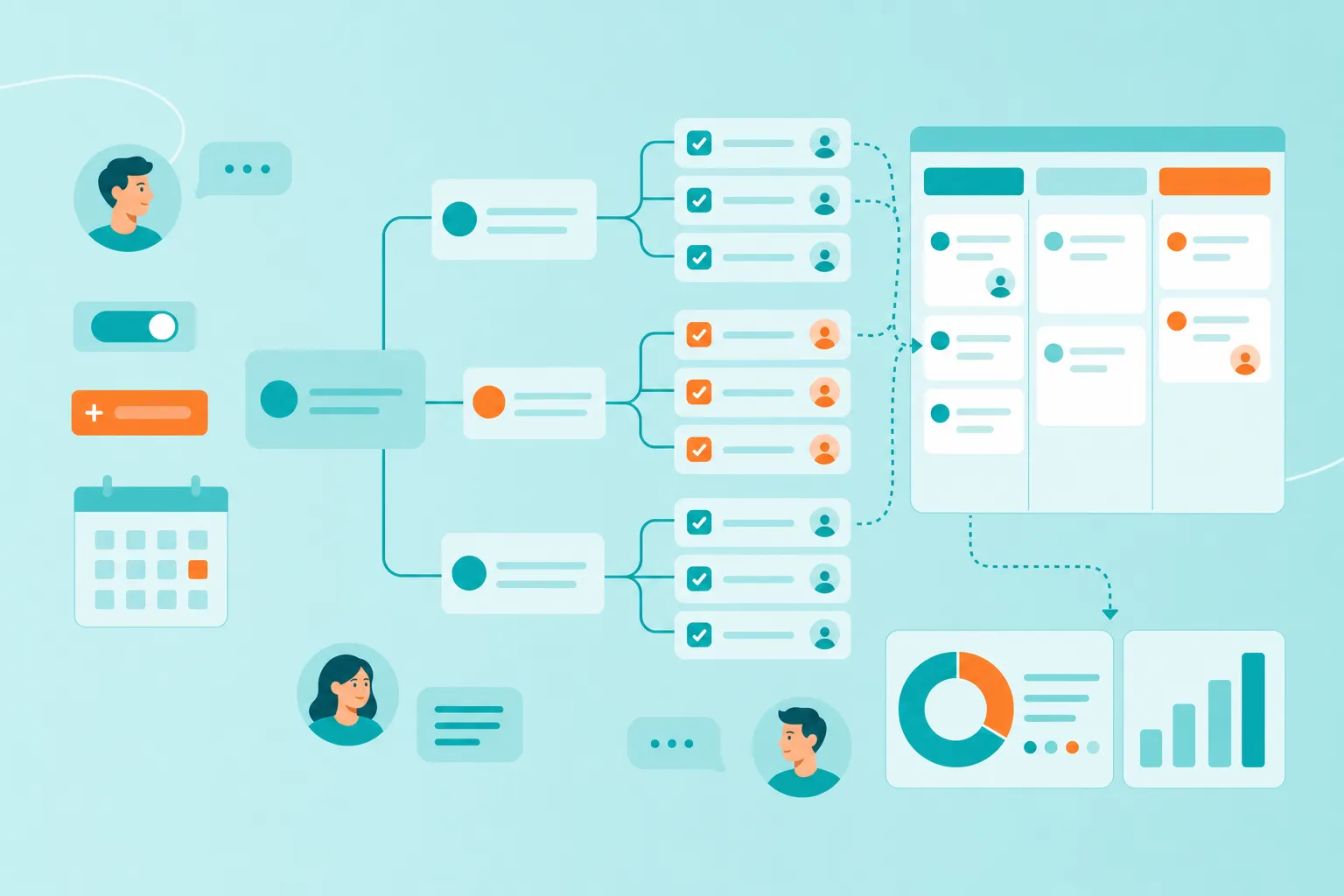
Go through the branches one by one. Read each idea aloud, and have the person who added it briefly clarify it. As themes emerge, the facilitator drags related branches together under shared theme nodes. Grouping as you go is one of the most useful mind mapping techniques for keeping a busy session readable. Your scattered feature ideas start to form clusters, such as onboarding, pricing and integrations. Everyone sees the same structure take shape, which keeps the review honest and clear for the whole team.
Step 4: Open the discussion
Now the group debates the clustered ideas. Challenge them, refine them and merge any duplicates. Remove weak ideas by consensus, not by whoever has the most seniority. The goal is a clean, shared shortlist that everyone understands the same way. Keep this stage focused on clarity, not persuasion, so the vote that follows reflects the ideas rather than the debate.
Step 5: Vote and rank
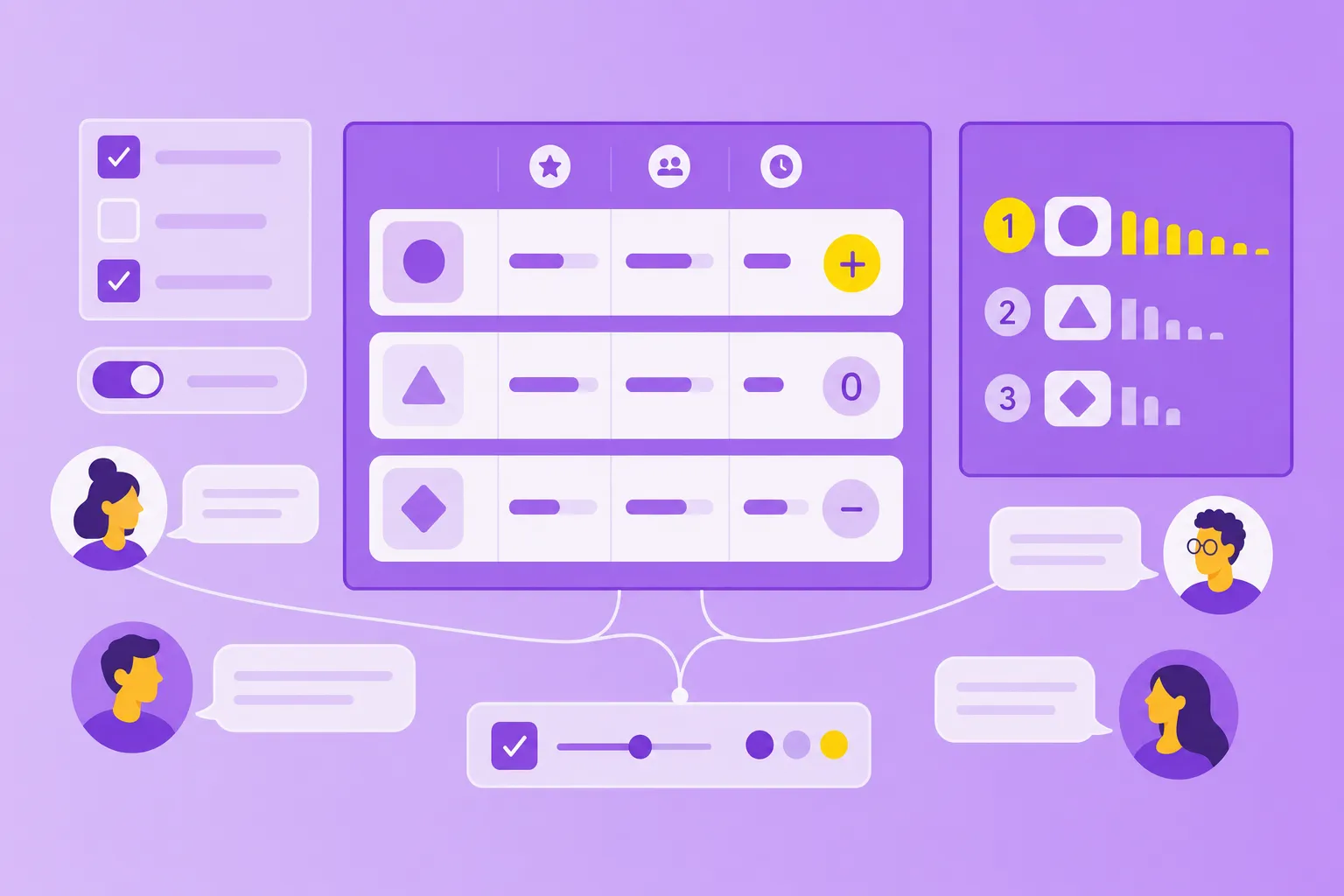
Ask each participant to mark their top 3 to 5 choices with a colored icon or a numbered tag. Voting privately, then adding the marks to the mind map, keeps the ranking about the ideas rather than about who argued hardest. The facilitator tallies the scores, and the highest-ranked ideas become the priorities. Add a priority branch that displays the ranked features with their scores. Your product team now has a ranked roadmap for next quarter that the whole group helped build, and the reasoning behind each choice stays on the roadmap for later reference.
The facilitator's job is to protect the structure, not to steer the outcome. That means enforcing the silence in step two, keeping the round-robin to one idea per turn and stopping anyone from debating during the sharing phase. It also means resisting the urge to merge similar ideas too early. Let the group see all the raw contributions before clustering. Premature grouping hides nuance and quietly kills ideas that look redundant on the surface but carry a different insight underneath. If the session runs long, the problem is usually the question, not the method. A question that is too broad produces too many branches. A question that is too narrow produces awkward silence. Spend a few minutes testing the question with one colleague before the session, and you will save time for everyone. Refine the question until it is specific enough to fill a mind map without overflowing it.
When to use the NGT, and when not to
The nominal group technique is a strong fit for some situations and the wrong choice for others. Knowing the difference saves you a frustrating meeting.
Remote and hybrid teams benefit from NGT even more than co-located ones. Video calls amplify the loudest-voice problem because turn-taking cues are harder to read on screen. Running the silent generation phase inside a shared MindMeister mind map means every participant can type simultaneously, and the facilitator can see contributions arrive in real time without anyone talking over anyone else. When the round-robin starts, each person simply walks the group through their branch. The mind map becomes the meeting's backbone, and the session recording is the mind map itself.
NGT earns its place in a few clear cases:
Dominant voices: the same few people talking in every meeting
A stuck team: a single problem circling with no clear decision
A need for priorities: a ranked shortlist instead of a long idea dump
Nervous newcomers: a low-pressure way for recent joiners to contribute
Skip NGT in these situations:
Large groups: more than 10 people, where the round-robin drags
Multiple problems: several questions at once, since NGT handles a single question at a time
Open exploration: a need for free creative flow rather than structured ranking
For that last case, classic brainstorming or affinity mapping to organize ideas after a brainstorm is a better fit, and it helps build a broader set of creative thinking techniques for teams, such as Six Thinking Hats for structured group thinking. Keep in mind that NGT also needs everyone available at the same time and a prepared facilitator, since facilitation is a real skill that shapes whether the session lands. Guidance from the University of Arkansas extension service points to a working group of roughly 5 to 9 people, small enough for a round-robin but large enough for varied input. For remote teams, a shared mind map keeps the same structure intact, since everyone generates, clusters, and ranks ideas in the same view, no matter where they sit.
The reason NGT changes outcomes is not the voting. It is the silent generation. Research consistently shows that groups produce more ideas and more diverse ideas when people think alone first and share second. The round-robin then gives every idea the same airtime, regardless of who proposed it. Junior team members, introverts and people working in a second language all benefit from this structure. Without it, the first confident speaker sets the frame and everyone else anchors to it. NGT breaks that anchor. It does not guarantee the best idea wins, but it guarantees the best idea gets heard.
NGT vs brainstorming: the key differences
Brainstorming and NGT often get lumped together, but they solve different problems. Brainstorming is generative and unstructured. Ideas build on each other in real time, which makes it a good fit for creative exploration. The trade-off is that it tends to favor whoever is most vocal in the room, and the group often circles the same few ideas. You end up with energy and volume, but rarely with a clear decision.
NGT is structured and sequential. It separates idea generation from discussion, gives every participant equal weight and ends with a ranked output instead of an unsorted list. Use online brainstorming with mind maps when you want to explore a problem space freely. Use NGT when you need to move from ideas to clear priorities in a single session. Many teams use both across a project, brainstorming early to open up options and running NGT later to narrow them down. If you are weighing options, it also helps to compare team brainstorming software before you commit to a format. In MindMeister, both approaches use the same mind map, so the difference lies in how you run the session, not which tool you open.
Turn ideas into priorities with MindMeister
The nominal group technique works because it gives every voice equal weight and ends with a ranked result that the whole team can stand behind. Its backbone is the silent generation phase, where ideas arrive without pressure, and the voting stage, where priorities become clear.

MindMeister gives that structure a home.
Turn ideas into priorities with MindMeister