


You have read the novel three times. You can name the characters, quote a few lines and describe roughly what happens. Yet when your teacher asks how the plot actually works, what drives each act, how the conflicts connect, why the ending resolves the way it does, you go quiet. That gap is common, and it is not a reading problem. It is a structure problem. A plot diagram makes the shape of a story visible, so you stop guessing at how it fits together and start seeing it. That is the difference between having read a story and understanding how it is built.
A plot diagram is usually drawn as a triangle in a textbook, but that flat shape has limits. MindMeister turns it into a branching map you can build, annotate and share on a free plan, so each stage of the story holds your notes instead of just a label.
What a plot diagram is and what it shows
A plot diagram is a visual tool that maps the five stages of a narrative: exposition, rising action, climax, falling action, and resolution, to show how a story's structure creates meaning. Each stage does a specific job. Exposition establishes the characters, the setting and the initial situation. Rising action builds conflict and tension through a series of complications. The climax is the turning point where the central conflict reaches its peak. The falling action shows the consequences of that turning point. Resolution shows how the conflict finally settles and what the new equilibrium looks like. Read the stages in order and you can trace how tension rises, breaks and settles across the whole text. The value comes from the relationships between the stages, not from the labels on their own.

This five-stage model has a long history. Aristotle described stories in terms of a beginning, a middle and an end, and the playwright Gustav Freytag extended that idea into the rising and falling structure teachers still use today, often called Freytag's pyramid. Useful as it is, the model is a starting point, not a rule. Some narratives are non-linear, some build to more than one climax, and some subvert the resolution on purpose. Mapping a story against the five stages is how you notice those choices, because you can see exactly where a text follows the pattern and where it breaks it. A tragedy that withholds a clean resolution, for example, reads very differently once you see that flat, unfinished shape sitting where the falling action should resolve. That contrast is the analysis: the map shows you the choice the writer made, and then you can argue why it matters. This is why English Literature teachers and students reach for a plot diagram when a text refuses to sit still. A plot diagram sits alongside other graphic organizers for reading and analysis to hold the whole structure in one view.
How to build a plot diagram mind map in MindMeister
MindMeister builds a plot diagram as a branching map rather than a triangle. The five stages are the same, and the branching format lets you add analysis, quotes and character notes under each stage instead of squeezing labels onto a flat line. That extra room matters because the notes under each stage are where your reading of the text actually lives. Here is how to build one, using John Steinbeck's Of Mice and Men as the worked example throughout.
Step 1: Place the title of the text in the central node
Open a blank map and type the title of your text, Of Mice and Men, in the central node. Everything else branches out from this center, which keeps the whole structure anchored to one story.
Step 2: Add the five stages as main branches
Add five main branches around the center: Exposition, Rising Action, Climax, Falling Action and Resolution. Place them in clockwise order, starting from the left, so you read the story's shape the way you read the story itself, from start to finish.
Step 3: Add the key events under each stage
Under each branch, add sub-branches for the key events in that stage. Keep these as keywords or short phrases, not full sentences. Under Exposition, you might add "ranch setting," "George and Lennie arrive," and "the dream of the farm."

Aim for three or four events per stage, enough to show the shape without turning the branch into a summary.
Step 4: Add characters and themes
Add a second layer of sub-branches for the characters involved in each event and the themes that the stage develops. Under the climax event, you might attach "Lennie," "Curley's wife," and themes such as "loneliness" and "the death of the dream." This second layer is where a plot diagram starts doing analytical work, because it forces you to connect what happens to why it matters. If the same theme surfaces under three different stages, that repetition is worth writing about, and the map makes it easy to spot.
Step 5: add a quotes branch where it counts
Add a Quotes branch under any stage where a specific quotation carries weight in your analysis. Attach the quotation text and the page or chapter reference, so your evidence sits next to the moment it supports. You do not need a quote for every stage; only for the ones where the exact wording carries the analysis. The same habit works when you take structured notes on your set text, so every quote you need is already mapped to the point it proves when you come to write an essay.
Plot diagram examples
Seeing the model applied to real texts makes it concrete. Here are three short plot diagram examples, each with a central node, five stages and a few sub-branch details.
Contemporary text: Finding Nemo
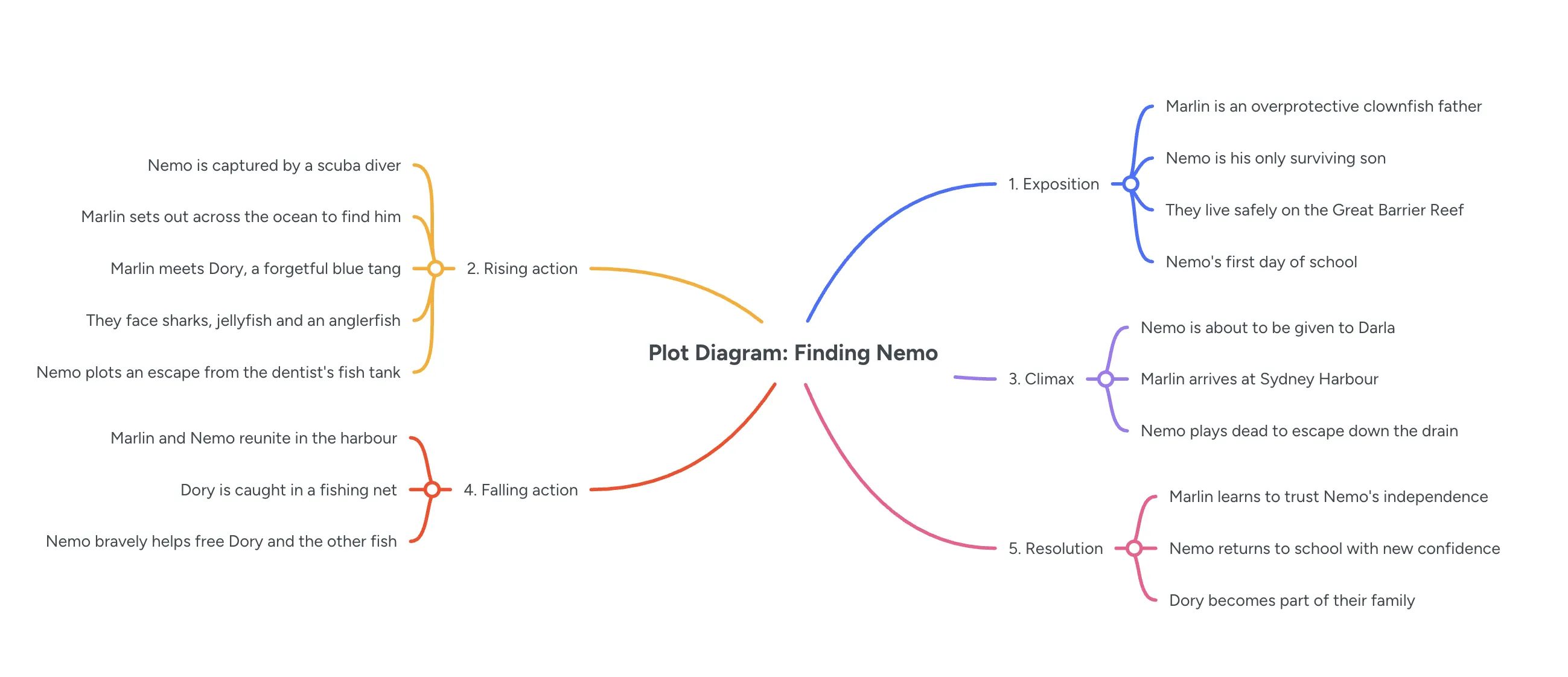
The five stages are not just for classic literature, and a familiar film proves it. With Finding Nemo in the center, exposition introduces Marlin, Nemo and the reef, and rising action follows Nemo's capture and Marlin's journey across the ocean through one obstacle after another. The climax branch holds the escape from the dentist's tank, falling action covers the reunion, and resolution shows Marlin changed, less fearful and more trusting, with themes such as loss and letting go mapped alongside. Seeing a children's film share the same skeleton as a Shakespeare tragedy is a useful reminder that the five stages describe structure, not difficulty.
Classic novel: The Great Gatsby
Put The Great Gatsby in the center and branch out the five stages. Exposition introduces Nick, Gatsby and the world of West Egg, with the green light as an early motif. Rising action tracks Gatsby's reunion with Daisy and the growing tension with Tom, while the climax branch holds the confrontation at the Plaza Hotel, where the affair breaks open. The falling action includes Myrtle's death and Gatsby's shooting, and the resolution maps Nick's disillusionment and retreat back east, with themes such as the American dream and class attached where they surface. Laid out this way, you can see how the green light in the exposition pays off in the resolution, which is the kind of connection a flat list of events tends to hide.
Play: Macbeth
For a play, the same structure maps neatly onto the acts. Place Macbeth in the center, then let each stage carry the scenes that drive it. Exposition holds the witches' prophecy, rising action centers on Duncan's murder and Macbeth's spiraling guilt, and the climax branch anchors the turn where Macbeth's power begins to collapse after Banquo's murder and the banquet scene. Falling action maps the march of Birnam Wood and the mounting rebellion; resolution records Macbeth's death; and you can pin quotations such as "Is this a dagger which I see before me" to the exact stage they belong to. Mapping the acts against the five stages also shows how quickly the play tips from rising action into consequence, which is a point you can build an essay around.
Using a plot diagram for creative writing
A plot diagram is not only an analysis tool, it is a planning tool that lets you map out the tension across your story before you write a word. Map the five stages as branches and populate each with the events, characters and turning points you intend to write. Under Rising Action, your sub-branches should show the sequence of complications that build toward the climax, one escalating on the next. The Climax branch should have one clear central event. If it sprouts five competing sub-branches, that is a sign the climax is not yet clear in your own mind. The Resolution branch should show the new equilibrium state and what has changed for your protagonist. Reading the branches from left to right, you can check that each stage earns the next, and that nothing important is missing before you commit to a full draft.
Building this map before you draft heads off the most common structural problem in student creative writing, a story that escalates but never resolves. It pairs well with mind maps for essay writing and literary analysis when you move from planning to prose, and with storyboard templates for planning your story when you want to sketch scenes visually. Plot diagrams organize the complexity of a story; they do not write it for you, and that is exactly the point: the thinking stays yours.
Map your story with a free plot diagram mind map